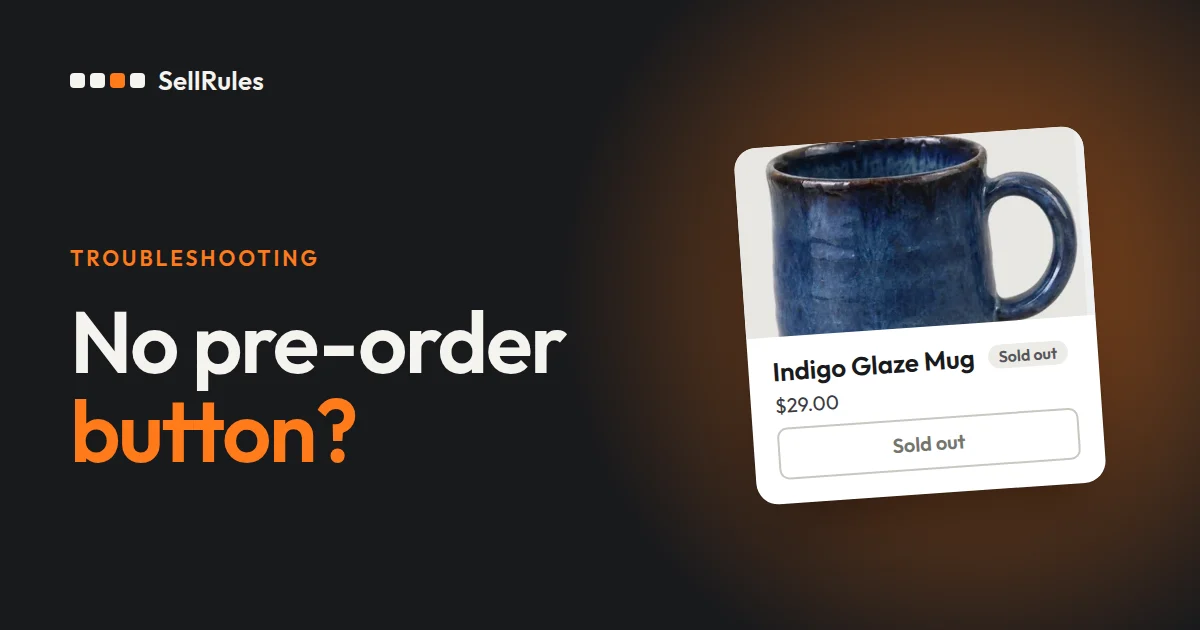
When the pre-order button isn't showing, what the product page shows right now tells you where to look. If every product still says “Add to cart”, start by checking that the SellRules app embed is on in your published theme. If it's only one product, check the phase and dates of its sales schedule. If a product that was taking pre-orders has switched back, look at the total quantity limit and the free limit.
If you see “Get Notified” or “Sales ended” where the pre-order button should be, it usually isn't a fault.
Quick reference: find the cause from what the product page shows
The three screenshots below show the same product page. Only the phase is different.
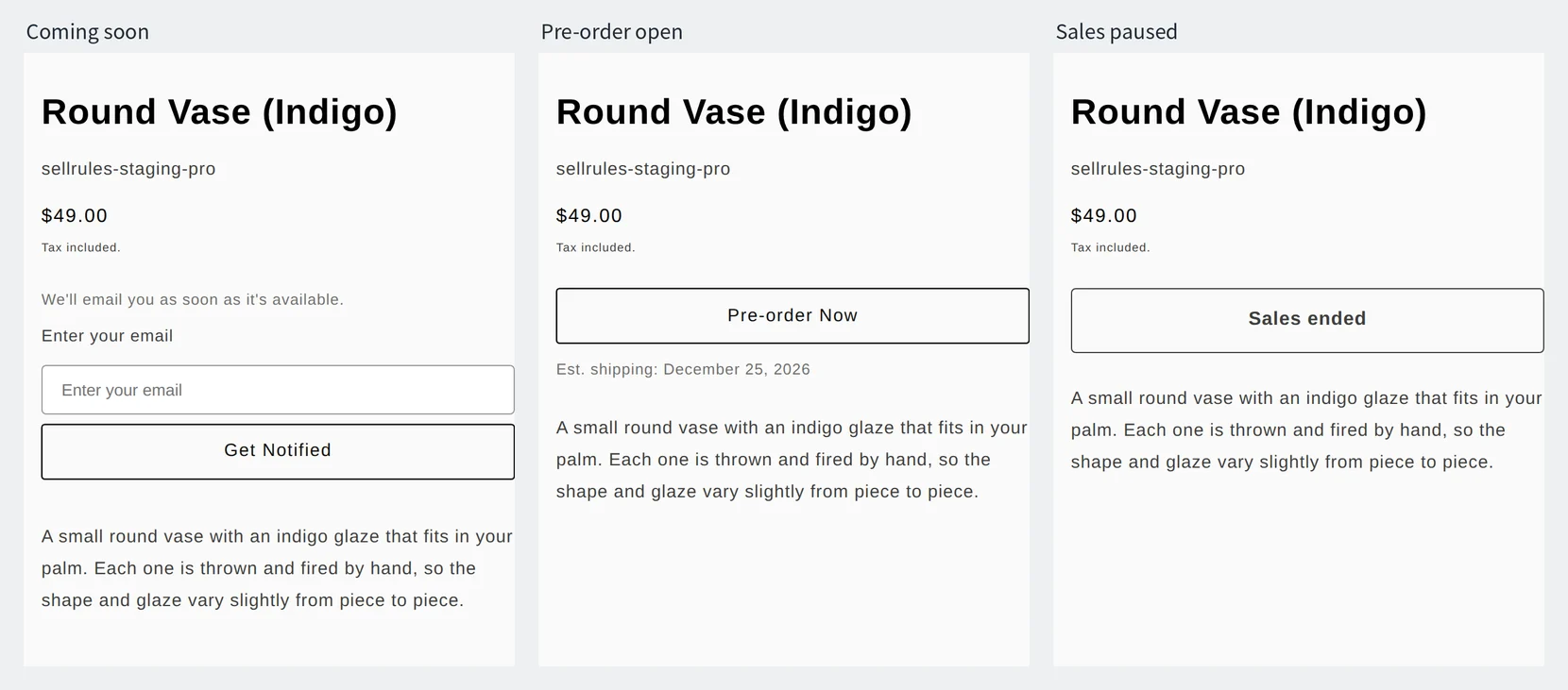
The left one is the coming-soon phase, the middle one is the pre-order phase, and the right one is a schedule with sales paused. All three match the phase that was set.
SellRules swaps the buy button on the product page to match the product's phase. So you get to the cause faster by starting from what customers see than by opening every settings screen in turn.
| What the product page shows | Likely cause | Where to check and how to fix it |
|---|---|---|
| Every product still shows the regular “Add to cart” | The SellRules app embed is off in your published theme (the same goes right after a theme change) | Turn it on under “App embeds” in the theme editor and save |
| Only one product, or only some variants, show the regular button | No schedule, pre-orders not started yet, or the selected variant has a different setting | Fix the products and dates in that product's row under “Sales schedules” |
| “Get Notified” and an email field instead of the button | The coming-soon period (working as intended). It appears on pre-order schedules and on schedules of the “Coming soon” type alike | Check that the phase shown in the list is “Coming soon”. Wait for the pre-order start time, or move the dates earlier |
| “Sales ended”, and it can't be clicked | Sales are paused, or the date sales end has passed | Resume sales in the schedule details, or fix the date |
| “Currently Unavailable”, and it can't be clicked | A purchase limit has stopped sales | Review the purchase limit rule |
| “You must be logged in to purchase this product.” below the button | A purchase limit requires customers to log in (working as intended) | To remove it, review the purchase limit rule |
| A product that was taking pre-orders went back to the regular button or an out-of-stock display | The total quantity limit was reached, or the end date passed (if you chose “Switch to regular sales”) | Raise the “Total quantity limit” in the schedule, or fix “When the pre-order ends” and its date |
| Pre-order and made-to-order products all stopped taking orders | The Free plan's lifetime order limit was reached | Look at the banner at the top of the app. Switching to the Launch plan brings them back |
| “Pre-order Now” is grayed out and can't be clicked | The payment terms for “Deposit now, balance later (partial payment)” are still being set up | Read the note below the button, wait a few minutes, and reload |
| The product page itself won't open | “Also switch Online Store publishing” is on, and it is before the “Coming soon start” or after the order end | Fix the dates in the schedule. Clearing the checkbox does not publish the product again, so publish it again from the product's edit page in the Shopify admin |
Work through it in this order: note what the product page shows, then check the app embed in your published theme, the phase and dates of the sales schedule, the limit, end setting, pause and free limit, and last the theme and other apps. The sections of this article follow the same order.
Missing on every product? Check the app embed in your published theme
If every product page still shows “Add to cart”, the theme's app embed is the first thing to check. The SellRules user guide says that with the embed off, “entering dates will not change the buy button.” The embed is also off on a new theme right after you switch themes.
Follow the steps in the Shopify Help Center. The place to open is “App embeds”, on the left side of the theme editor.
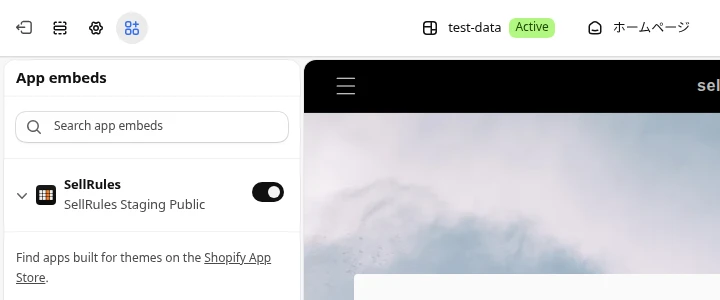
- In the Shopify admin, go to “Online Store → Themes” and click “Edit theme” on your published theme
- If you sell in several markets, pick the affected market from the market selector at the top. If you don't pick one, the change applies to your store's default settings
- Open “App embeds” in the left sidebar
- Turn the SellRules switch on
- Click “Save”, then open the product page on your live store again
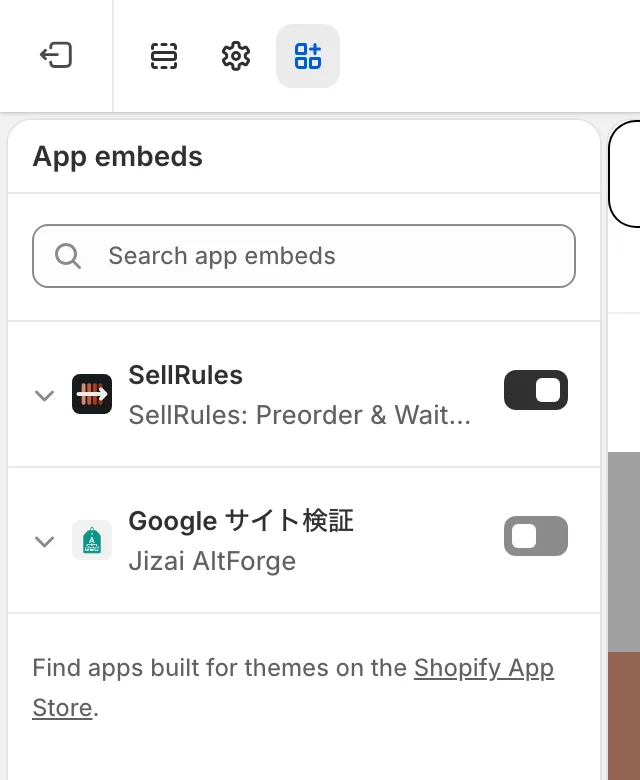
“App embeds” in step 3 is Shopify's name for this panel. SellRules uses the same name on its own screens, for example on the “Open app embeds” button.
The step people miss is “Save” in step 5. The theme editor preview shows the embed as on before you save. It can look fixed, but nothing changes for customers until you save.
You can also confirm the fix in the “Setup guide” on the SellRules “Home” screen. The “Turn on SellRules in your theme” item changes to “It's on: SellRules was confirmed working on a product page.” once a product page is opened on your live store and SellRules switches the display. The theme editor preview does not count for this check.
If the item doesn't get confirmed, the app tells you to check these 4 points.
- You opened the product page in your actual store, not in the theme editor preview
- The theme with SellRules turned on is your published theme
- The product is published
- If it still isn't confirmed after opening the product page, the app proxy URL under “Settings → Apps → SellRules” in Shopify is
/apps/smart-preorder
SellRules keeps watching the settings of your published theme after the item has been confirmed. If the embed gets turned off, Home shows the warning “SellRules is turned off in your published theme.” with an “Open app embeds” button. The warning is there so you don't reach launch day without noticing that the theme was swapped. If you see it, check the embed first.
The official SellRules guide assumes a theme that supports app embeds (Online Store 2.0). You don't need to edit any theme code.
Missing on one product? Compare the phase and dates of its sales schedule
If only one product still shows the regular button, look for that product's row under “Sales schedules” in SellRules. If there is a row, the phase it is in right now decides what the product page shows.
| Phase in the list | What the product page shows (default text) |
|---|---|
| Coming soon | An email field and a “Get Notified” button |
| Pre-order | A “Pre-order Now” button |
| Made to order | An “Order now” button |
| On sale | Your theme's own buy button (regular sales) |
| Sales ended | “Sales ended”, and it can't be clicked |
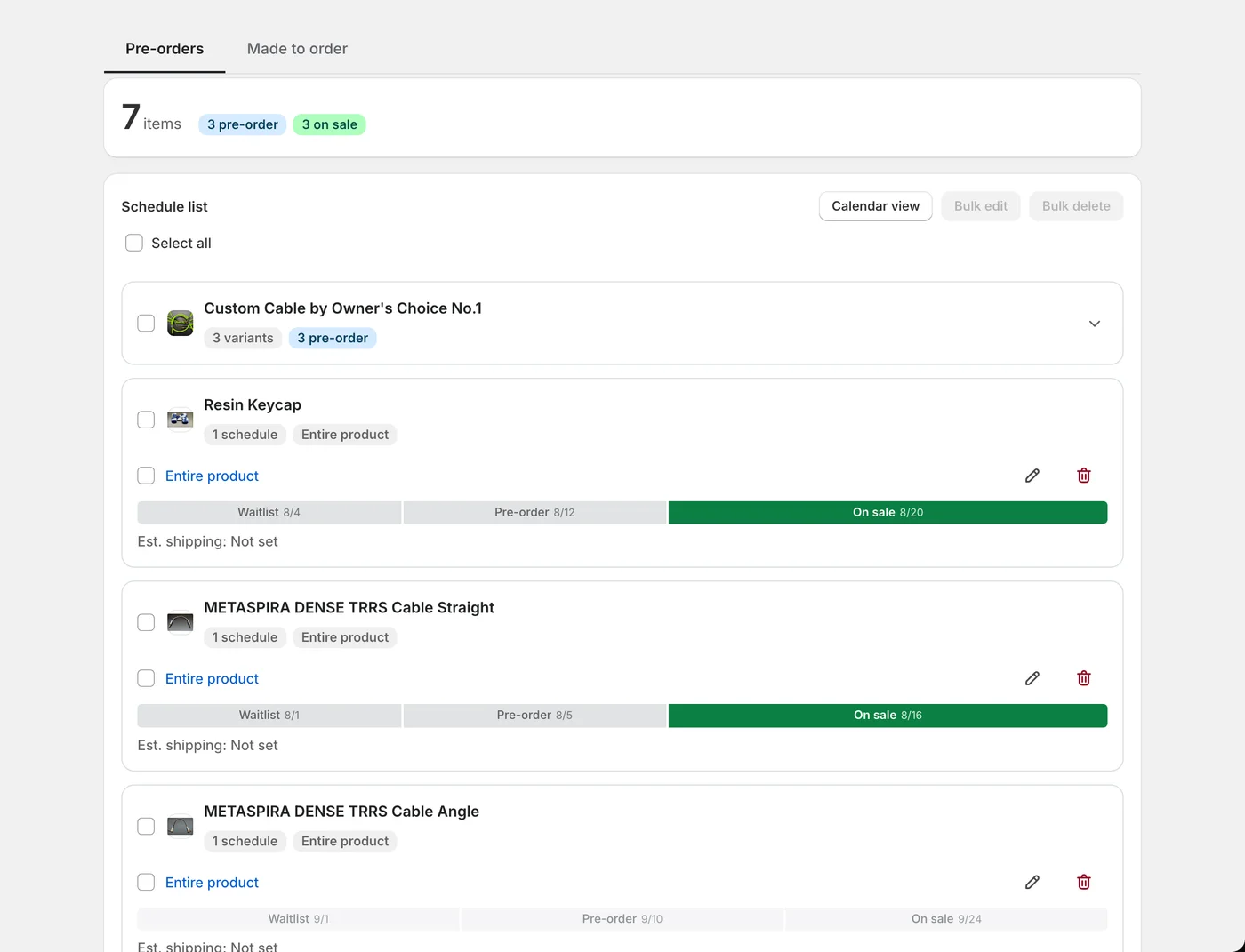
You can change the button and field text under “Button and label text” in “Settings”. If you have changed it, read the table above with your own wording in place of the defaults.
If the phase shown in the list is “Coming soon”, nothing is wrong with the display. The coming-soon period is when you collect notification sign-ups before launch, so the page shows an email sign-up field in place of the pre-order button. From the pre-order start time, pages opened after that show the pre-order button.
In SellRules, “Coming soon” is also the name of a schedule type, separate from the phase: a schedule with no pre-order period. A schedule of that type shows the same sign-up field during its coming-soon period. The difference comes afterward: at the sale start time it goes back to the regular buy button and never takes pre-orders. If you want pre-orders on that product, create it again as a pre-order schedule.
If the product has no row, you haven't created a schedule for it yet. Under “Sales schedules”, click “Create pre-order”, enter the product and the dates, and save.
If there is a row and the button still isn't a pre-order button, open the edit screen and go over these points.
- Whether pre-orders have started yet: if you set no coming-soon period and the pre-order start is still ahead, the product sells as usual until then
- The order of the dates: the dates have to run coming-soon start, pre-order start, switch to regular sales. If they don't, the timeline bar on the edit screen shows “Dates are out of order. Use this order: coming soon, pre-order, regular sales.” If you try to save anyway, an error such as “Coming-soon start must be before pre-order start” appears and the schedule isn't saved
- Time zone: compare the note “Dates and times are saved in your store's time zone (…)” on the create screen with the time zone under “Settings → General” in Shopify. If the store is set to a time zone other than the one you work in, the switch happens at a different hour than you expect
- Variant-level settings: SellRules uses a variant's own schedule if there is one, and the whole-product schedule if there isn't. If you created only variant-level schedules and nothing for the whole product, the variants you didn't set up keep selling as usual
- Whether the product is published: draft products, and products not published to the Online Store, don't appear to customers at all. With “Also switch Online Store publishing” turned on in the schedule, SellRules unpublishes the product before the coming-soon start and after the order end. Clearing this checkbox leaves the product in whatever publishing state it is in at that moment, so publish it again from the product's edit page in the Shopify admin
For example, say you created a variant-level pre-order only for “Black / M” of a T-shirt. When a customer picks “White / M”, the page goes back to the regular “Add to cart”, and when they switch to “Black / M” it becomes “Pre-order Now”. That is what the settings say. To take pre-orders on every color, create a schedule for the whole product.
Why did the button disappear from a product that was taking pre-orders?
If a product that was taking pre-orders yesterday is back to the regular button or an out-of-stock display, the cause is probably not a wrong setting. More likely the product has hit one of the conditions that stop orders. SellRules stops taking orders under 4 conditions.
The first is reaching the total quantity limit. If the schedule has a total quantity limit, SellRules stops taking pre-orders as soon as the total number of units ordered reaches it (one order for 2 units counts as 2). To take pre-orders again, raise the limit.
The second is passing the end date of the pre-order. What the page shows after the end date depends on what you chose under “When the pre-order ends” on the edit screen.
| Choice under “When the pre-order ends” | Product page after it ends |
|---|---|
| Switch to regular sales | Your theme's own buy button |
| End sales and show "Sales ended" | “Sales ended”, and it can't be clicked. It does not go back to regular sales |
| No deadline (keep taking pre-orders) | The pre-order button stays until you stop it yourself |
The third is a pause. “Pause sales” in the schedule details stops purchases without deleting the settings, and customers see “Sales ended” for as long as the pause lasts. The dates keep moving during the pause, so when you resume, SellRules works out the phase again from the date and time at that moment.
The fourth is reaching the Free plan's lifetime order limit. On the Free plan you can take up to 10 pre-order and made-to-order orders in total, counted from the day you installed the app. When you reach that limit, a banner appears at the top of the app that begins “Pre-order and made-to-order orders have reached the free limit (10).” Pre-order and made-to-order product pages stop taking orders, including ones that were open for orders, and the list shows “Not published (free limit reached)”.
Your settings are kept, and switching to the Launch plan brings everything back right away.
Apart from these, during the pre-order and made-to-order phases SellRules sets the inventory policy of the variants in the schedule to “Sell when out of stock”. Inventory reaching 0 does not make the pre-order button disappear by itself. If the button went away at 0 inventory, look at the 4 conditions above.
What if nothing changes after the pre-order start time?
If the start time has passed and the page hasn't changed, reload the product page first. If it still hasn't changed, check the dates and time zone, and whether the change reached the product page.
SellRules rewrites the data for the product page at 4 times: the coming-soon start, the pre-order start, the switch to regular sales, and the end. How a page that a customer already has open changes, though, depends on the schedule type.
- Pre-orders and made-to-order sales: A page that is left open does not change by itself when the time passes. Customers who opened the page and are waiting for the pre-order start see the pre-order button (or the order button for made-to-order products) once they reload. The switch to regular sales and the end of sales work the same way: reloading brings up the new display.
- Schedules of the “Coming soon” type: If the sale start time comes within 24 hours of the page being opened, the page goes back to the buy button at that time, even if it is left open. A page that has been open since more than 24 hours before the sale start shows the buy button once it is reloaded.
A line such as “Please reload the page at the start time” in your launch announcement saves waiting customers from wondering what to do.
When you check on your own screen, go in this order so no old display is left over.
- Reload without the cache (Ctrl+F5 on Windows, Command+Shift+R on Mac)
- Open the product page in a private window or another browser, so you see it the way customers do
If it still doesn't change, think back to whether you saw “Created successfully, but updating the product page failed.” after creating the schedule. In that case the app updates the page again automatically every few minutes. To update it right away, open the edit screen and save again.
What if the pre-order button shows but customers can't buy?
If the button is there and no orders come in, read the note below the button. SellRules shows the reason a customer can't buy close to the button.
| Text near the button | Reason |
|---|---|
| “You must be logged in to purchase this product.” | A purchase limit lets only logged-in customers buy |
| “This product is available only to eligible customers” | A purchase limit lets only customers with a certain tag buy |
| “This product is currently not available for purchase.” | A purchase limit has stopped sales. The button reads “Currently Unavailable” and can't be clicked |
| “This product can't be purchased yet because payment setup is still in progress. Please reload the page in a few minutes.” | The payment terms for a deposit are still being sent to Shopify |
The first three rows are what your purchase limits tell the page to show. If you see one of them and never meant to sell to members only, review the purchase limits on that product.
A pre-order with “Block purchases during the announcement period” turned on also shows only the sign-up field during the coming-soon period (the “announcement period” in that setting's name), and customers can't buy. At the pre-order start time, it changes to the pre-order button.
Settings are right but the button is missing or out of place? Rule out the theme and other apps
If the embed and the schedule are both right and the page still shows the regular button, or the button sits in the wrong place, look at the theme's purchase form and at other apps.
SellRules looks for the buy button in your theme's product form and swaps it. If the theme has been rebuilt with a purchase form shaped differently from the standard one, SellRules may not find the button. When it hasn't found one after 5 seconds, on product pages in the pre-order, made-to-order or coming-soon phase, SellRules inserts its own button or sign-up field into the product page, so it can appear in a different place from the theme's button.
If an error happens partway through, SellRules leaves the theme's own button in place so customers aren't left unable to buy. Depending on what happened, the console in your browser's developer tools keeps one of these entries.
| Console entry | Meaning |
|---|---|
[SellRules] Button replaced: … | The button was swapped (working as intended) |
[SellRules] Could not find form/button after 50 retries | The theme's purchase form or button could not be found |
[SellRules] Fail-open recovery | After an error or a timeout, the theme's own button was put back |
Including the entry when you contact support makes the cause easier to narrow down.
The display also clashes when another app rewrites the same buy button. To compare without touching your published theme, go in this order.
- In Shopify, go to “Online Store → Themes” and duplicate your published theme
- In the preview of the unpublished copy, open the same product and the same variant
- Turn off the embeds of other apps that change the buy button or the product form, one at a time, and compare the display
- When the symptom changes, write down the theme name, that app's name, the product and variant, and what the screen showed
If you turn off every app at once, you can't tell which one caused it. Compare them one at a time.
What SellRules settings can't fix, and who to contact
SellRules does not guarantee the same display on every theme. If you have checked everything so far and it still isn't fixed, the cause may lie outside the SellRules settings.
- A purchase form with custom-edited theme code: SellRules does not rewrite your theme's code. Ask the theme's developer or the agency that built it about the form's structure
- Overlap with another app: tell the support team of the app you identified in the previous section about the symptom as well
- Problems with Shopify's own display or checkout: for problems that happen at checkout and not on the product page, contact Shopify Support
When you contact SellRules, the details below make it easier to reproduce what you see.
- Your store URL (your-store.myshopify.com)
- The name of your published theme and, if you sell in several markets, the affected market
- The product name and the name of the affected variant
- The date and time it happened (in your store's time zone)
- What you expected to see and what appeared (for example, “the phase is Pre-order, but the page still shows Add to cart”)
- Screenshots of the product page and the “Sales schedules” screen
- The names of any other apps you use that change the buy button
- The text of any console entry that starts with
[SellRules]
You can write to us through the contact page, or use “Feature request” or “Bug report” at the bottom of the app screen. You don't need to send your customers' personal details (names or addresses).
Frequently Asked Questions
Why is there an email field on a product I never created a schedule for?
It comes from a sold-out switch. If a product is set to “Back-in-stock notification only” under “Sold-out switches”, SellRules creates a schedule on its own when inventory reaches 0 and shows the same kind of sign-up field. In the “Sales schedules” list, that row is marked “Auto”. This is not a coming-soon period, so waiting will not turn it into a pre-order button. To take pre-orders on that product, create a pre-order schedule for it.
I changed the app proxy URL. Will every pre-order button stop working?
No, not all of them. A store with a changed URL can no longer use the standard route, but SellRules has a backup route that sends requests straight to the app's server. The “Unsubscribe” and “Cancel this order” links in notification emails may stop opening, though, so go to “Settings → Apps → SellRules” in Shopify and set the app proxy URL back to /apps/smart-preorder.
What do customers with JavaScript turned off see?
They see your theme's own button, not the pre-order button, because SellRules runs on JavaScript. Below the purchase form, a note reads “Enable JavaScript to see pre-order and back-in-stock information.”
After the fix: keep it from happening again on launch day
Once it's fixed, make two things a habit so the same problem doesn't come back at your next launch.
The first is to check the app embed the same day you change themes. Whether the embed is on or off is set per theme, so when you swap themes or switch to a sale theme, the setting of the theme you switch to is the one that applies. Check Home for the warning at the same time.
The second is to run the same dates once on a test product by the day before launch. On a published test product, set the coming-soon start and the pre-order start close together, and look at both the coming-soon display and “Pre-order Now” after the start on your live store. You can check how it works with your theme without touching the real product.
Check your plan as well. Automatic pre-order switching and notification sign-ups during the coming-soon period are available from the Free plan. The Free plan does have limits: up to 10 pre-order and made-to-order orders in total since you installed the app, and up to 15 notification emails in total.
For a store where orders keep coming with every launch, the Launch plan (US$7.99 per month, with a 10-day free trial) is the one to look at. Choose the Launch plan too if you want to take pre-orders with a deposit.
These articles cover the next steps in setup.
- Seeing what else SellRules does: SellRules features
- Checking everything from the first setting onward: How to start taking pre-orders
- Launch time, and planning the coming-soon period through regular sales: Automatic switching at launch time
- The order to try things in on one product before you keep the app: Five-minute quick start (run a pre-order on a test product)
- Deposit setup steps and the payment methods that work: How to take a deposit on pre-orders
- Deciding the overall rules for early-access and limited sales: Rules for early-access and limited sales
- Collecting sign-ups before launch: Collect notification sign-ups before launch
- Limits on purchase quantity: Setting a “limit one per customer” rule
The screens and on-screen text are based on the SellRules app (as of November 11, 2026) and the user guide. The three product page screenshots were taken on a test store the same day. The theme editor steps follow the Shopify Help Center article “Extend your theme with apps” (checked November 11, 2026), and pricing matches the Shopify App Store listing.