When reviewing packaging material costs, calculate per-item expenses from the amounts your store actually paid rather than using market averages posted on retail websites. Divide the purchase price and shipping fees by the usable quantity, then sum them for each material used to protect the product. Adding shipping postage lets you compare the total cost incurred per shipment.
Calculating Packaging Material Costs per Shipment
First, write down all the materials used for a single order. Include not only envelopes and boxes, but also inner bags, cushioning, tape, and shipping label paper. If materials are shared across multiple items, allocate costs proportionally according to the actual length, surface area, or piece count used.
Deriving Unit Costs from Purchase Records
Calculate the per-unit cost of a material by dividing the purchase price plus any incurred shipping fees by the quantity that is actually usable. If multiple materials are used in a package set, add the unit costs of each material.
Cost per material unit = (Purchase amount + shipping fees paid at purchase, etc.) ÷ Usable quantity
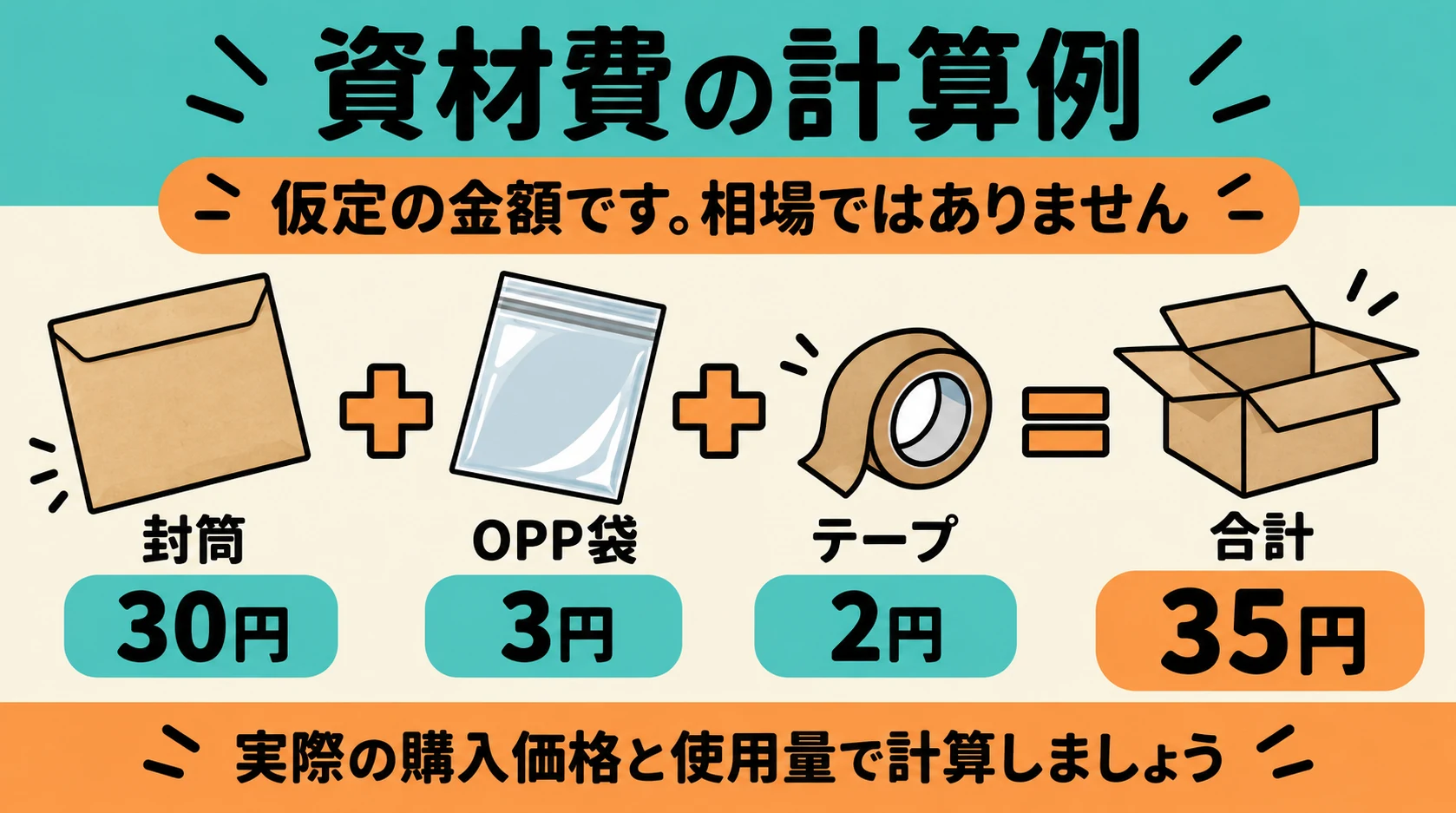
For example, the following is a hypothetical example to demonstrate the calculation method, not a market average. If you use an envelope worth 30 yen, an OPP bag worth 3 yen, and 2 yen worth of tape for one shipment, the material cost is 30 yen + 3 yen + 2 yen = 35 yen. Because these are not prices verified in physical stores or on retail websites, replace them with your store's actual procurement records.
You may not always be able to use every unit purchased. If you have damaged materials or inventory you could not use due to size mismatches, calculating the unit cost based on the quantity actually usable for shipping makes it easier to accurately grasp your expenses.
Adding Postage to Calculate Total Cost per Shipment
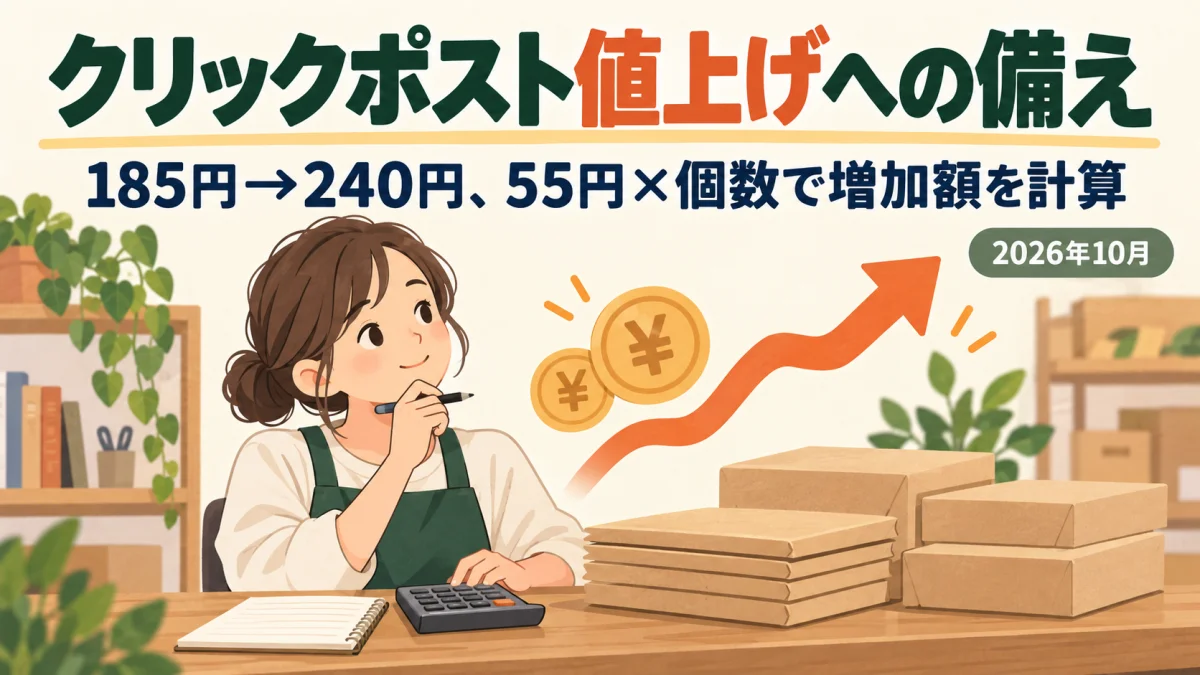
When comparing shipping costs, record postage and material expenses separately before totaling them. Using Click Post's current postage of 240 yen and the hypothetical material cost of 35 yen, the cost per shipment is 240 yen + 35 yen = 275 yen. If 100 shipments are made every month for 12 months under identical conditions, material costs amount to 35 yen × 1,200 shipments = 42,000 yen, and 330,000 yen when combined with postage.
This estimate is a hypothetical example fixing shipment volume, material costs, and postage. In reality, material types and quantities vary by order, so record them by representative product or calculate an average cost from monthly purchase totals and shipping volume. For Click Post, effective October 1, 2026, the nationwide flat rate is 240 yen for packages up to 2 kg, longest side within 34 cm, total dimensions (3 sides) within 60 cm, and that can physically be dropped into a post box (Japan Post’s official service information). The previous 185 yen, 1 kg, and thickness within 3 cm were criteria prior to the revision.
Choosing Packaging Materials to Match Your Products
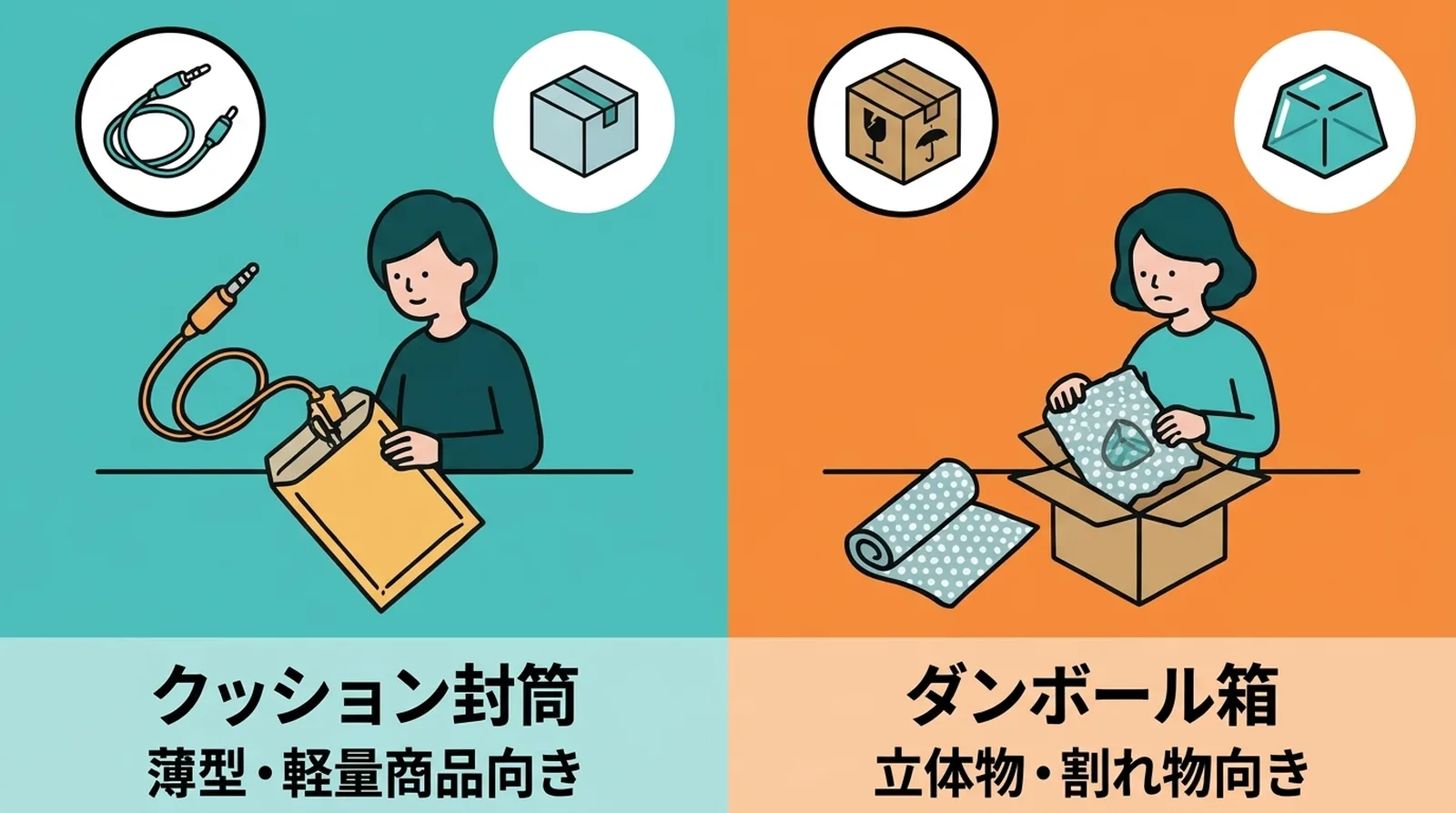
Deciding on materials based solely on price can result in insufficient protection for your products or cause the packaged parcel to exceed the dimension limits of your delivery service. Select the packaging shape capable of protecting the product first, then compare purchase prices and usage amounts for the necessary materials.
| Material | Use Cases | Points to Consider When Choosing |
|---|---|---|
| Padded envelope | Thin products or items requiring cushioning inside the envelope | Inner dimensions, envelope thickness itself, outer dimensions after inserting the product |
| Cardboard box | Three-dimensional products or parcels where external pressure must be avoided | Inner and outer box dimensions, thickness after assembly, storage space |
| OPP bag | Inner bags to separate and protect products from dust and water droplets | Inner bag dimensions, sealing margin, whether additional outer protection is required |
| Bubble wrap | When you want to protect product surfaces or corners | Thickness after wrapping around the product, required length, wrapping layers |
| Tissue paper | When you want to avoid surface scuffing or contact between items | Required protective coverage for the product and combination with other cushioning |
| Cardboard envelope / backing board | When you want to send thin products flat | Stiffness of the backing board, corner protection, dimensions after packaging |
Each material requires a different form depending on the product. For instance, paper goods that should not bend can have a backing board added, and items that should not get wet can be placed inside an inner bag before choosing outer packaging. For fragile goods, do not decide based solely on envelope versus box; check whether the item can move inside the packaging and whether corners and surfaces are adequately protected.
Comparing Actual Supplier Prices Under the Same Conditions
Packaging material prices vary by size, sheet count, shipping fees, and time of purchase. Rather than assuming uniform market averages, record prices from actual sales pages or quotes at the time of purchase.
Items to Record in a Comparison Table
| Comparison Item | Details to Check |
|---|---|
| Material specifications | Outer and inner dimensions, thickness, material, presence of water resistance or cushioning |
| Purchase quantity | Number of sheets/units received per order |
| Total amount paid | Item price, shipping fees, handling fees, applied discounts |
| Usable quantity | Usable quantity for shipping, excluding trial samples and damaged pieces |
| Cost per unit | Total amount paid divided by usable quantity |
| Storage and inventory | Storage space, time required to exhaust inventory, surplus in case of specification changes |
Compare materials with identical dimensions and specifications, and record the date you checked the purchase page. Even if the displayed unit price of a bulk pack is lower, actual shipping costs may not decrease if extra shipping fees apply, if it takes up storage space, or if part of the stock is left over because it does not fit your products.
Deciding on Bulk Purchases by Assessing Usage and Storage Space
While buying in bulk can reduce the unit price, this does not apply to all materials. Check the total purchase amount against your projected usage volume, and consider where inventory will be stored and how long it will take to use up before placing an order.
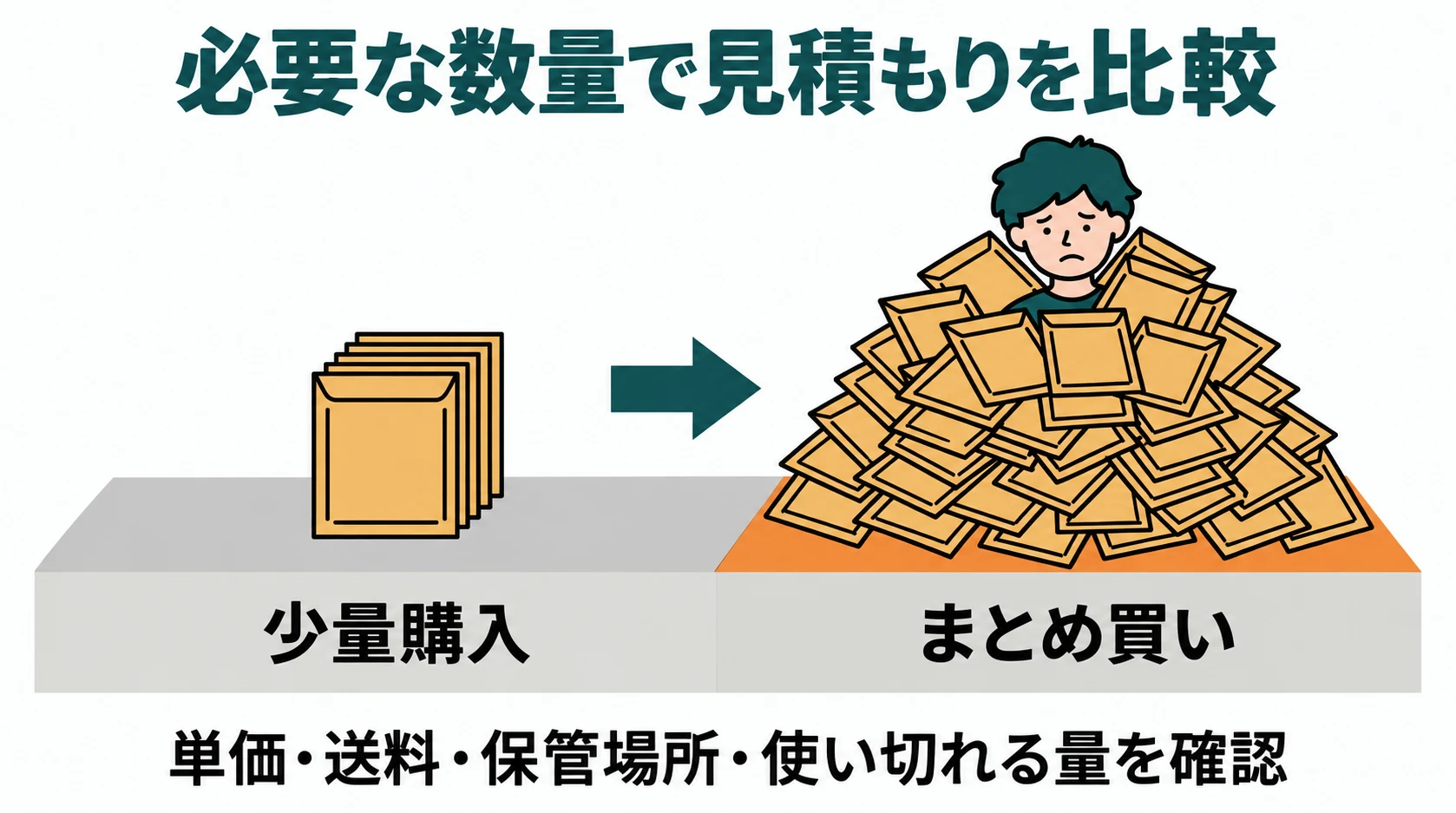
When using a material for the first time or changing sizes to accommodate a new product, package the actual item in small quantities first. Check outer dimensions after sealing, confirm whether the product moves inside, and see if inventory fits on workbenches or storage shelves before deciding on your next order quantity.
When comparing, proceed in the following order:
- Record the specifications of currently used materials and monthly consumption volume
- Check total purchase amounts for small-volume and bulk-volume products with the same specifications
- Add shipping fees and other expenses, then calculate the price per usable unit
- Consider storage space and the possibility that products or packaging methods may change before stock is exhausted
- Reassess purchase quantities once materials tested in small quantities have proven usable without issues
Balancing Product Protection and Labor Time
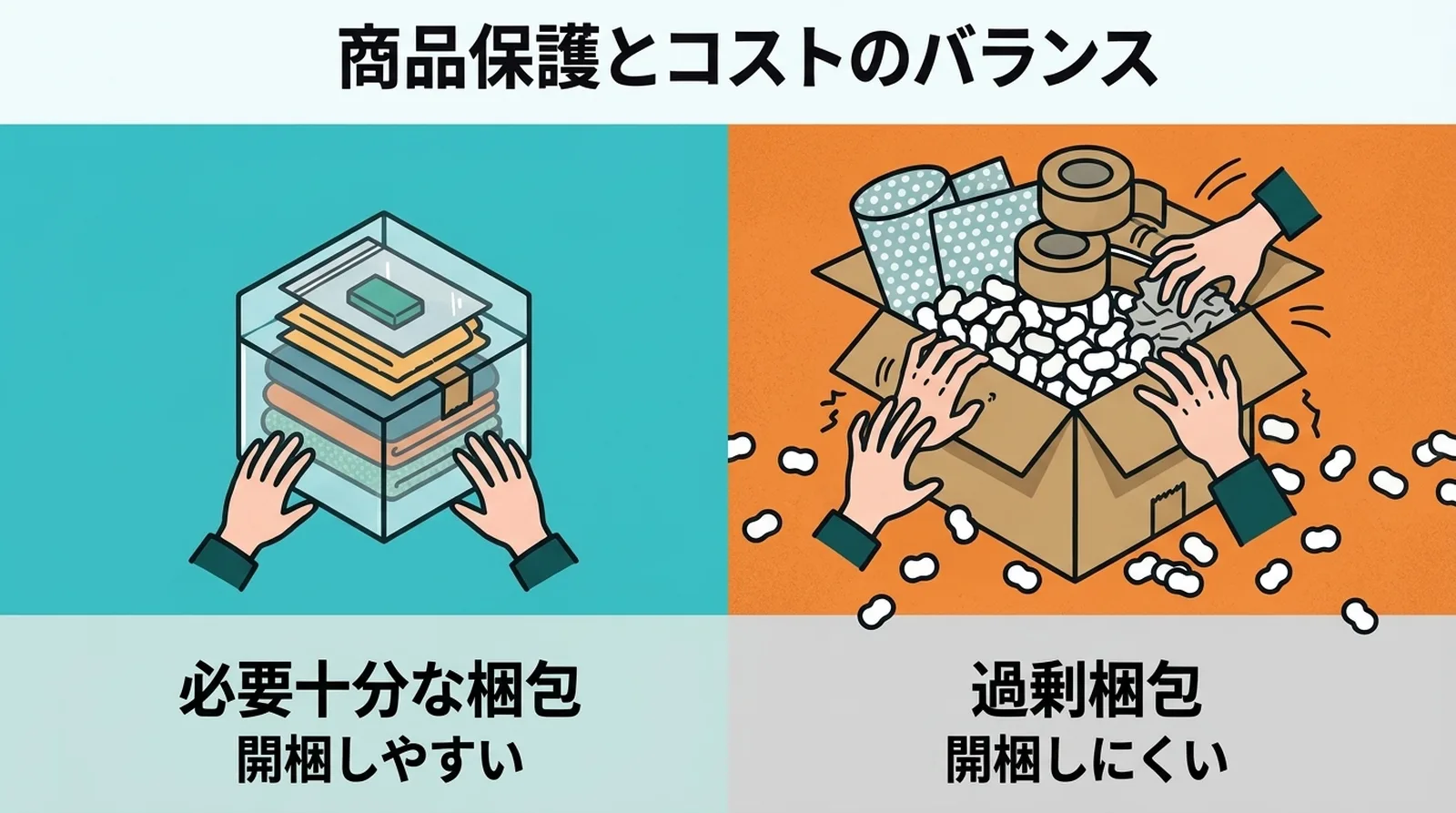
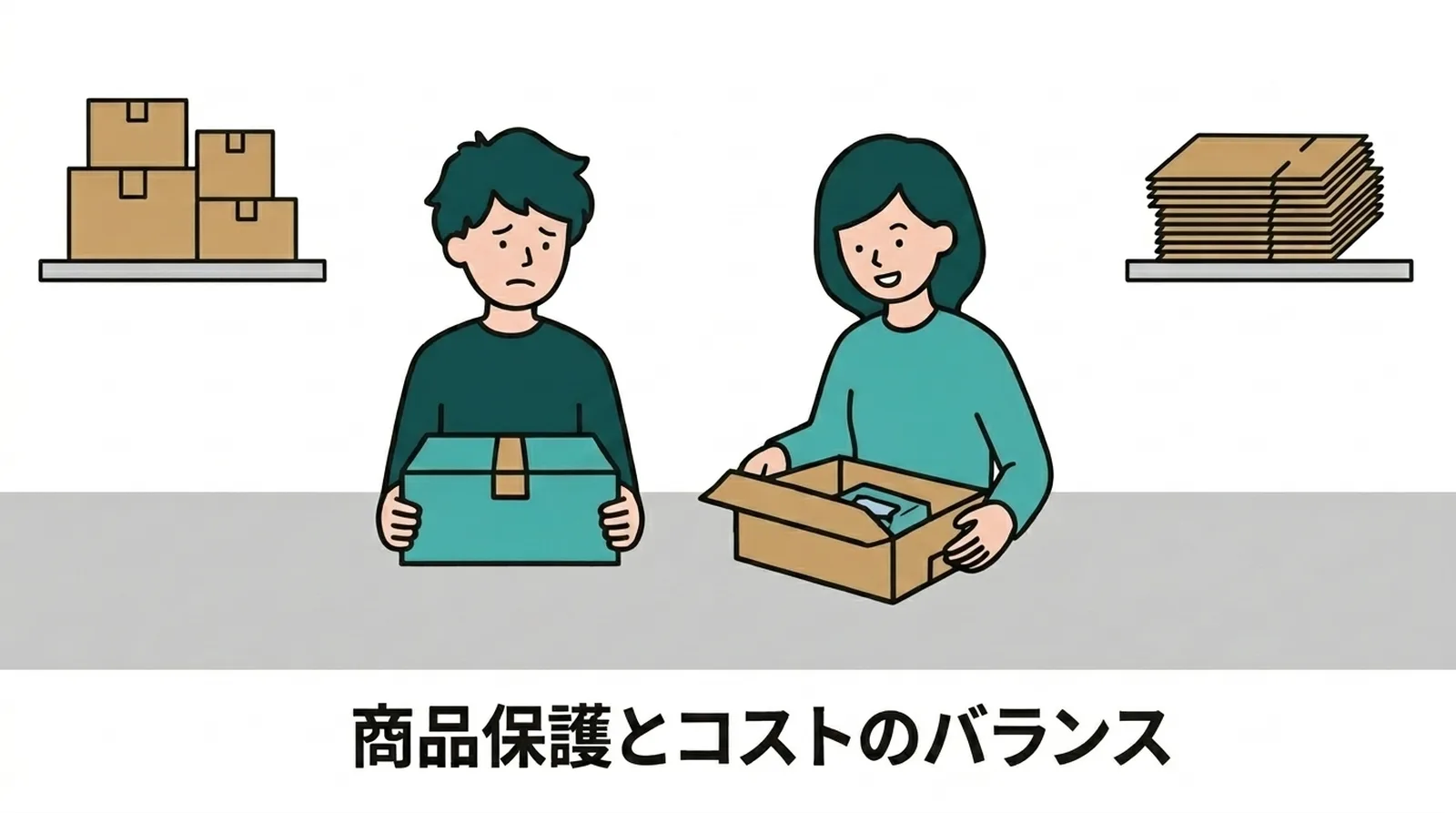
The goal of packaging is to deliver the product to the buyer in the required condition. Reducing protection solely to lower material costs risks scuffs or breakage during transit. On the other hand, layering unnecessary materials onto a product affects not only purchase costs, but also packaging time and parcel dimensions.
When reviewing packaging, identify the specific areas you need to protect for each product and add necessary materials one by one. After increasing or decreasing cushioning, remeasure outer dimensions and weight in sealed condition. If limits for the delivery method are exceeded, do not force the parcel in; adjust the packaging or change the delivery service.
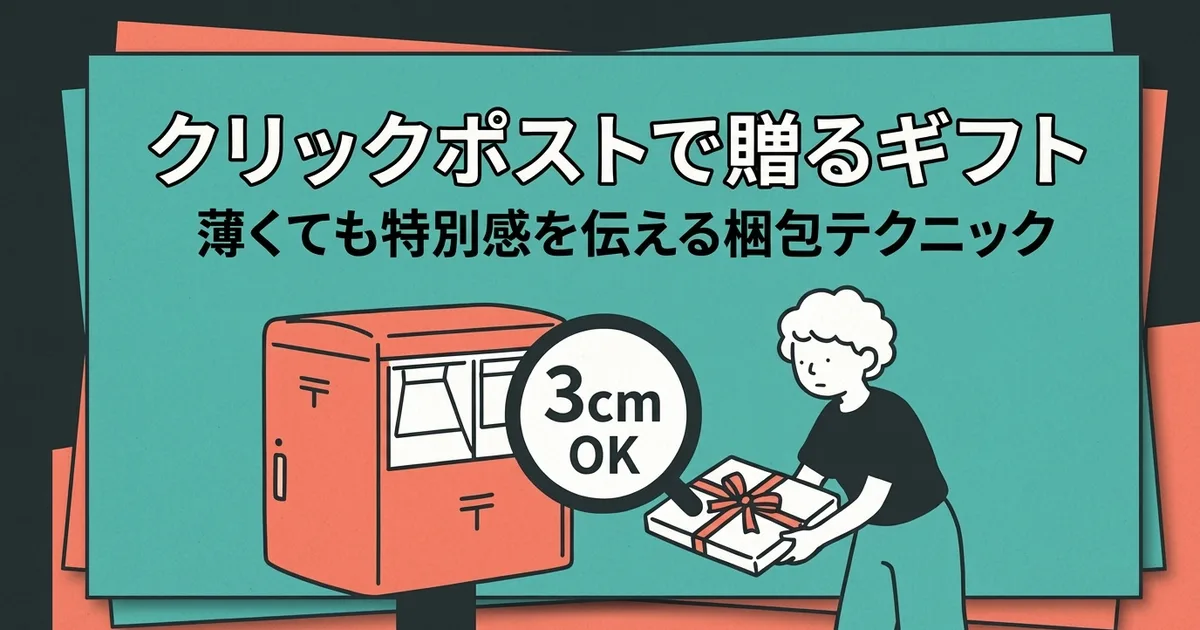
When using Click Post, current criteria are packages up to 2 kg, longest side within 34 cm, total dimensions (3 sides) within 60 cm, and that can physically be dropped into a post box. The previous condition of thickness within 3 cm is historical record up to September 30, 2026. The current post-office counter drop-off exception is strictly limited to packages with a thickness of 3 cm or less. Because a sizing ruler alone cannot guarantee drop-in acceptance, check the shape after packaging and the slot of the specific post box you plan to use.
Keeping Packaging Material Purchase Records
To regularly review packaging material expenses, retain the purchase date, vendor, material specifications, purchase quantity, total amount paid, and start date of use. Keeping online order histories and receipts together makes it easier to spot procurement price changes or material transitions.
Tax treatment regarding expense classifications and timing of recognition varies depending on business structure and accounting methods. This article does not determine the definitive accounting approach. If tax determinations are required, consult a resource capable of assessing store-specific circumstances, such as National Tax Agency guidance or a licensed tax accountant.
Frequently Asked Questions
Q. How do you calculate the packaging material cost per shipment?
Add purchasing-related costs such as shipping fees and handling charges to the purchase amount of envelopes, inner bags, cushioning, tape, labels, and other materials, and divide by the number of units that are actually usable. If you use multiple materials, sum the per-unit cost of each material.
Q. Does buying packaging materials in bulk always make them cheaper?
It does not necessarily make them cheaper. Compare not only the purchase price, but also shipping fees, the number of usable units, storage space, and the risk of surplus inventory if product specifications change. Review sales pages or quotes for both small and bulk quantities under the same criteria.
Q. How should packaging material purchases be treated for tax purposes?
Because tax treatment varies depending on factors such as business structure and accounting methods, this article does not determine expense classifications or timing of recognition. Keep your purchase records and consult a resource capable of assessing your individual circumstances, such as National Tax Agency guidance or a licensed tax accountant.
Summary
Calculate packaging material costs per shipment from actual purchase amounts and usable quantities. By recording product prices, shipping fees, and handling charges together rather than relying on unfounded market averages, you can compare options using your store's actual purchasing conditions.
Before increasing purchase quantities, inspect material dimensions and protective condition using actual samples. After packaging, measure parcel outer dimensions and weight to ensure they meet the criteria of your selected delivery method. Recording postage and packaging material costs separately makes it easier to review shipping costs for each product.
If you also want to streamline Shopify order CSVs and tracking number updates, check out Instant Shipping! for Click Post.
For the full workflow for shipping with Click Post from Shopify, see the Shopify Click Post shipping guide.
Recommended Reading
- Comparing Rates and Conditions for Click Post, Yu-Packet, and Nekopos — Choosing a shipping method by comparing rates and size conditions
- Checking Click Post Thickness and Drop-in Conditions — How to verify packaged dimensions and post box drop-in acceptance
- Preventing Rain Damage and Breakage with Click Post Packaging — Protective methods tailored to your products